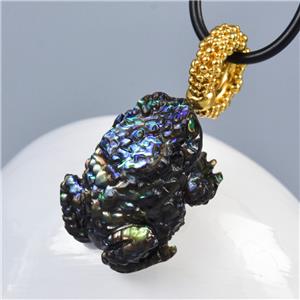
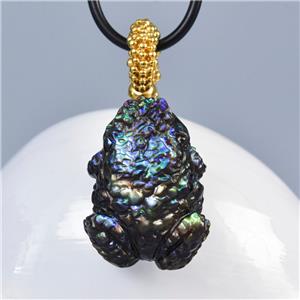
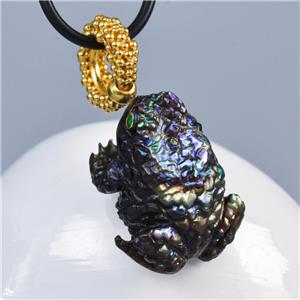
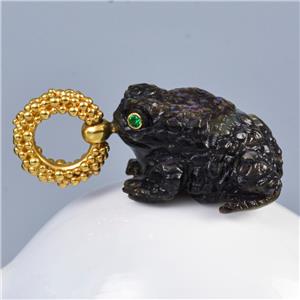
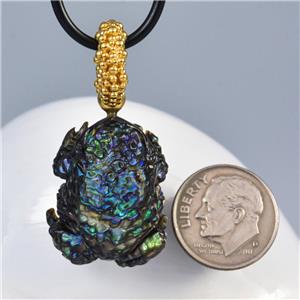
| | MULTICOLOR SHELL TOAD CARVING & 18K GOLD VERMEIL over 925 STERLING SILVER
|
|
| | Item # | : | 183 16577
| |
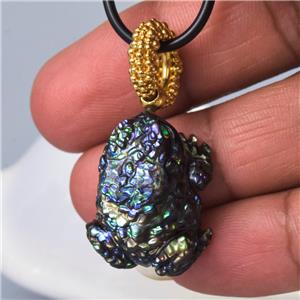
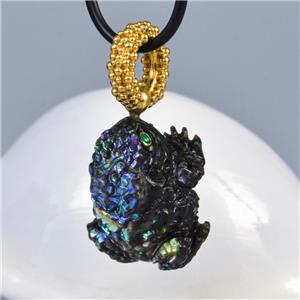
| | Type of carving | : | Multicolor shell three-dimensional carving pendant (amulet / charm)
| |
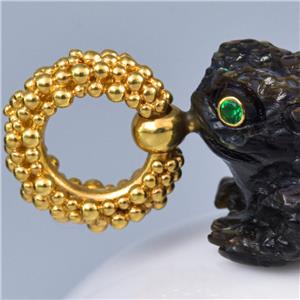
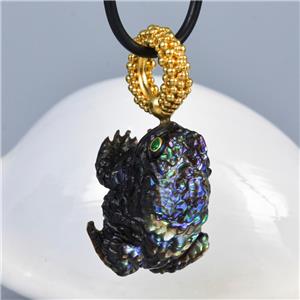
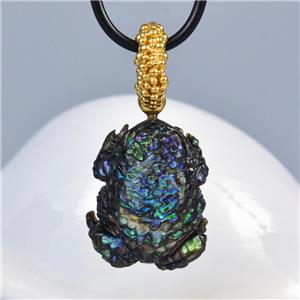
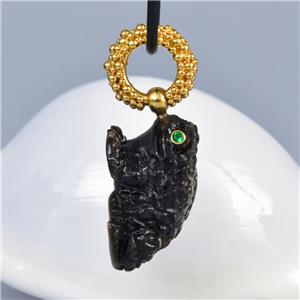
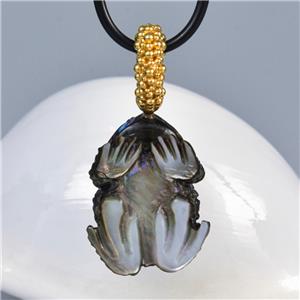
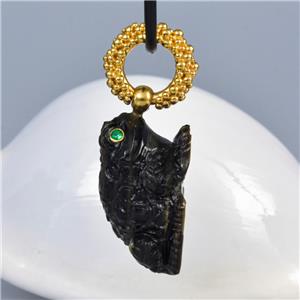
| | Design | : | Ornate TOAD FROG design with a fine Bali granulation bail ~ 3-dimentional carving in exceptional fine details.
The eyes are made out of bezel-set in 18K Gold Vermeil over Sterling Silver inlayed genuine natural gemstones.
| |
| | Material | : | Natural black Mother-of-Pearl shell, multicolor Paua Abalone shell, Emerald gemstonesl and 18K Gold Vermeil over genuine solid Sterling Silver ~ 18K gold-plated 3-microns.
| |
| | Plating | : | Very thick and durable ~ 3-microns 18K yellow Gold Vermeil over solid 925 Sterling Silver
| |
| | Amount | : | 1 (one) individual piece
* All photos are taken from the actual item *
| |
| | Weight | : | approx. 11.24 grams
| |
| | Size | : | Length: approx. 40.15 mm = 1.58 inches
Width: approx. 19.82 mm
Depth: approx. 14.36 mm
All measurements are taken at the widest points
| |
| | Bail | : | The bail inside measurement is 7.90 x 6.90 mm and will fit a chain, rope or cord with a diameter of 6.80 mm and smaller.
The cord shown in the photos is for display only and is not included.
| |
| | Definition Bali Granulation | : | Old-world Gold and Silver smithing brings the past into the present with detailed surface decoration that suits antique and contemporary designs
Granulation, the art of creating a surface pattern on jewelry with tiny silver or gold balls, dates back to the third millennium BC. The technique, invented in the Eastern Mediterranean and Egypt and later refined by Etruscan goldsmiths, looks as fresh and inventive today as it must have then.
The process begins when wire is cut into short lengths and melted into round granules that are placed on the jewelry in the desired pattern. They’re held in place with temporary “glue” made from plant sap. In the best examples, the balls are attached permanently with heating (which evaporates the glue), not soldering. But it’s a difficult process because the temperature has to be hot enough to fuse the tiny ball to the surface, but not enough to melt the ball into an amorphous puddle.
Granulation involves only high-karat Silver or Gold. The purer the material, the easier it will be to achieve the fusion required for granulation.
People are instantly attracted to granulation because of the connection to ancient cultures.
| |
| | Origin | : | Hand-carved by Balinese master-craftsmen
The silverwork is handmade by out in-house master silversmiths.
| |
| | Color | : | Bronze black Mother-of-pearl, multicolor Paua Abalone shell, green and gold
| |
| | Quality | : | New and excellent
| |
| | Treatment | : | None ~ 100 % natural shell which is hand-carved and polished
| |
| | Hand-crafted | : | This jewelry is made using ancient traditional techniques. Each piece is handmade and is not a machine mass produced item.
Each piece, silver parts and carvings are made one by one which make each piece a one-of-a-kind.
| |
| | Hallmark stamp | : | This amulet pendant is hallmark stamped 925.
| |
| | Black Mother-of-Pearl | : | Pinctada margaritifera ~ Black-lip Pearl Oyster
Pinctada margaritifera, commonly known as the black-lip pearl oyster, is a species of pearl oyster, a saltwater clam, a marine bivalve mollusk in the family Pteriidae. This species is common in the Indo-Pacific within tropical coral reefs.
The ability of P. margaritifera to produce pearls means that the species is a valuable resource to humans. The oysters are harvested wild from coral reefs and are also commonly grown in aquaculture, both primarily taking place in the Indo-Pacific region.
The common name of this species refers to the black coloring along the margins of the interior of the shell. Externally the shell is dark grayish brown or green, though white spots are common across the shell. Adults usually reach between 20 and 25 cm (7.9 and 9.8 inches) in height.
| |
| | Paua Abalone shell | :
| Paua shell is produced by the New Zealand Abalone (Haliotis iris), the most colorful shell.
The name Paua is the name the Maori call the shell we know as Abalone from the deep waters of the South Island of New Zealand.
These waters are a lot colder being so close to the Antarctic Basin. This is why the colors of Paua Abalone are more vibrant and deeper in color than any other Abalone found in the world.
The lustrous iridescence is a rainbow blue, green and various shades of red.
This Paua Abalone shell is an inspiration from nature’s spectrum of rainbow colors.
| |
| | Origin | : | We buy all our shell material from the pearl farms (aqua culture) off the coast of the Island of Sumbawa and all our Paua Abalone shell material directly from New Zealand.
This shell carving is handcrafted in Bali (Indonesia) by our in-house Balinese shell carvers.
| |
| | What is Gold Vermeil? | : | VERMEIL, which is pronounced "vehr-MAY," is 925 Sterling Silver with is plated with Gold.
Vermeil is a combination of Sterling Silver and Gold commonly used as a component in jewelry. A typical example is Sterling Silver coated with 18K or 24K Gold. To be considered VERMEIL, the gold must be at least 10 karats (42%) and be at least 2.5 micrometers thick. In the US and various other countries, Sterling Silver covered first with a base metal (such as nickel) and then plated with Gold cannot be sold as vermeil without disclosing that it contains base metal.
The word "VERMEIL" is a French word which came into use in the English language, mostly in America, in the 19th century as an alternative for the usual term silver-gilt.
Vermeil can be produced by either fire-gilding or electrolysis. The original fire-gilding process was developed in France in the mid-18th century; however, France later banned the production of vermeil because over time artisans developed blindness due to mercury involved in the process. Today, VERMEIL is produced by electrolysis which is much safer than fire gilding yet produces a very similar result
The White House has a collection of vermeil tableware kept on display (when not in use) in the Vermeil Room.
The Code of Federal Regulations 16, Part 23.5 defines Vermeil: "An industry product may be described or marked as 'vermeil' if it consists of a base of Sterling Silver coated or plated on all significant surfaces with Gold or Gold alloy of not less than 10 karat fineness, that is of substantial thickness and a minimum thickness throughout equivalent to two and one half (2 ½) microns (or approximately 1/10000ths of an inch) of fine Gold."
Less than 2.5 microns is NOT Vermeil and is considered as simple Gold plating only.
Vermeil Jewelry
Vermeil is a more expensive version of Gold plated jewelry. It consists of a 925 Sterling Silver base that is coated or plated with Gold.
And again, if the longest lifespan is in the first place for you, your option is VERMEIL
Vermeil is much more durable than simple very thin gold plating.
No wonder that the price is also high.
Gold plated jewelry
Gold plating is the term used to describe the process of plating jewelry made of either precious (silver) or non-precious base metal (zinc, nickel, copper) with a thin layer of gold, which is depositing by electrochemical methods. As it was said the layer is very thin and thus easy to scratch. It also naturally wears thin with time, exposing the metal below.
| |
| | Definition Bali granulation | : | Old-world Gold and Silver smithing brings the past into the present with detailed surface decoration that suits antique and contemporary designs
Granulation, the art of creating a surface pattern on jewelry with tiny silver or gold balls, dates back to the third millennium BC. The technique, invented in the Eastern Mediterranean and Egypt and later refined by Etruscan goldsmiths, looks as fresh and inventive today as it must have then.
The process begins when wire is cut into short lengths and melted into round granules that are placed on the jewelry in the desired pattern. They’re held in place with temporary “glue” made from plant sap. In the best examples, the balls are attached permanently with heating (which evaporates the glue), not soldering. But it’s a difficult process because the temperature has to be hot enough to fuse the tiny ball to the surface, but not enough to melt the ball into an amorphous puddle.
Granulation involves only high-karat Silver or Gold. The purer the material, the easier it will be to achieve the fusion required for granulation.
People are instantly attracted to granulation because of the connection to ancient cultures.
| |
| | Remarks | : | This multicolor shell carving, gemstones & 18K Gold Vermeil over solid 925 Sterling Silver pendant is absolutely marvelous and made with exceptional detail.
The condition is new and excellent.
Don’t miss this opportunity to own this beautiful statement charm pendant | |
| | | | | | |